Three domains no newsroom leader can ignore



Think of a pink elephant – once you notice it, you can’t unsee it.
That’s how it has been for me with newsroom leadership: ever since I began studying it, I see everywhere how decisive it is for what takes root in a newsroom – and what grinds to a halt.
Over the past four years I’ve spoken with more than a hundred editors-in-chief, team leads, reporters, educators, researchers and news innovators in the Netherlands and beyond. I’ve devoured books and reports, joined international leadership programmes (and followed a few myself), and worked daily in my own roles – as lecturer, deputy editor-in-chief, coach, researcher and now Genre Coordinator Journalism at NPO – around one central question:
❓ How do we keep journalism relevant and valuable for people – and what role does leadership play in that?
And like that pink elephant, I now see it everywhere:
Leadership shapes what takes off in newsrooms and what gets stuck. Who feels heard and who doesn’t. How journalism evolves – or stands still. And ultimately, the role journalism plays in people’s lives.
Why leadership matters more than we admit
Leadership is a crucial yet often overlooked factor in our field.
It influences newsroom culture, public trust, how we deal with workload, professional standards, product innovation, uncertainty, technological change – and each other. Yet we rarely talk about it. Even less do we develop it consciously and systematically.
That leaves those in the lead, the teams they guide, and the society they serve, short-changed.
Which is why I want to keep researching, making visible, and working with others on leadership that keeps journalism strong, relevant and meaningful.
Towards a compass for leadership
As Dutch scholar Manon Ruijters puts it: without a norm, there can be no reflection. You can’t develop something if you haven’t defined what it is.
In journalism we seldom make explicit what we mean by leadership, what we expect of it, or what is needed now in different roles. Many assumptions remain implicit – and many images outdated. Meanwhile, the context has shifted dramatically: new technologies, changing audience behaviour, fresh organisational models and pressure on business models all call for more diverse and contemporary forms of leadership than the old path of “moving up from reporter to chief or editor-in-chief”.
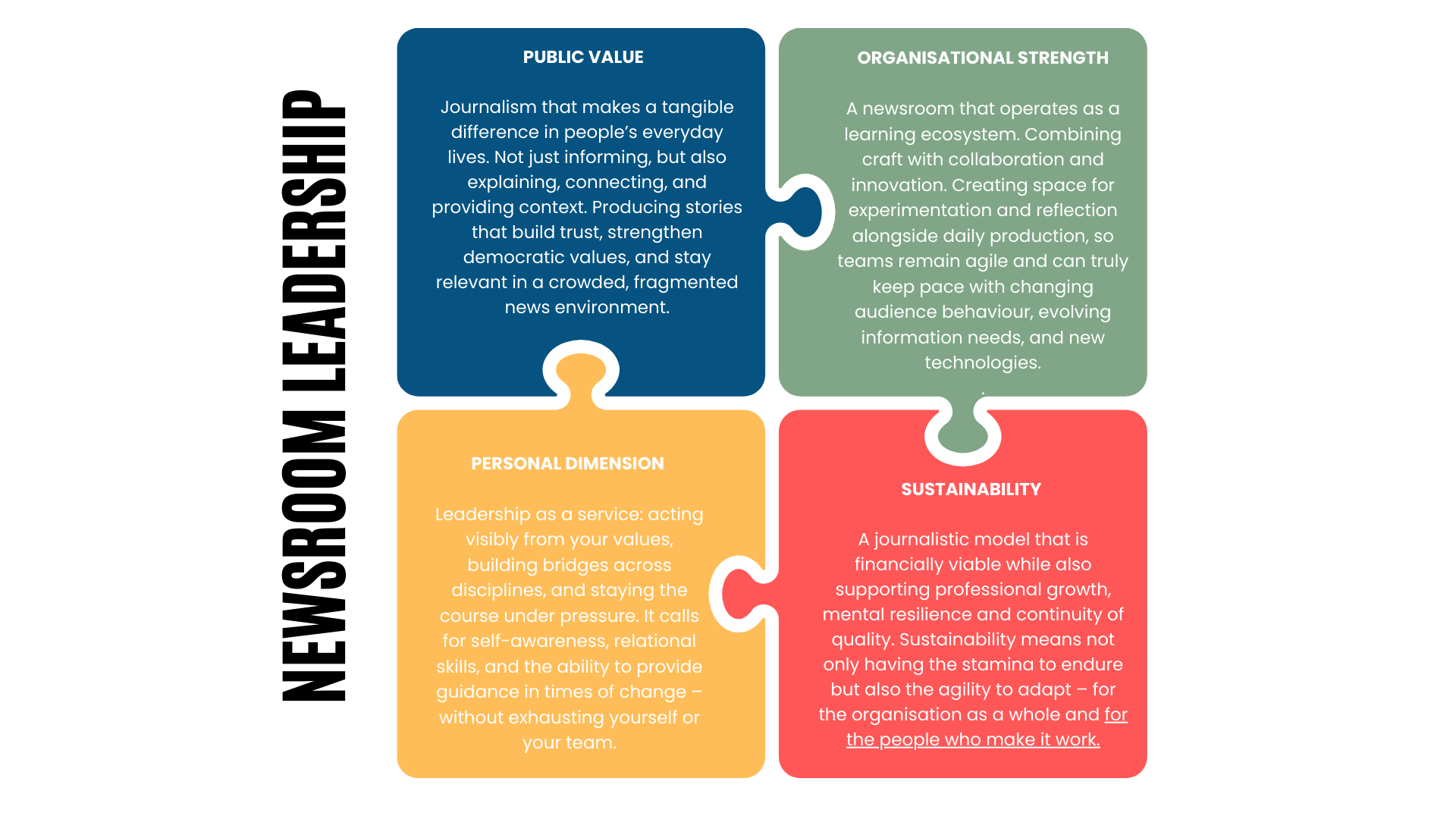
What we need is a shared professional frame: a dynamic framework that makes leadership tangible and provides direction. Such a frame can give:
- researchers a basis to measure what works,
- organisations a foundation to steer more purposefully (via OKRs, KPIs or other tools), and
- leaders themselves a clear language to discuss what is expected – in terms of work, knowledge, skills and attitude.
Making those expectations explicit – and showing how people can develop towards them – is vital for learning, renewal and growth. In journalism, where leaders at every level shape how teams work, innovate and collaborate, this isn’t a luxury. It’s a necessity.
A “norm” here should never be a straitjacket. It’s more like a compass: dynamic, adaptive, and rooted in today’s challenges, creating a culture where feedback is natural and growth possible.
Three domains of newsroom leadership
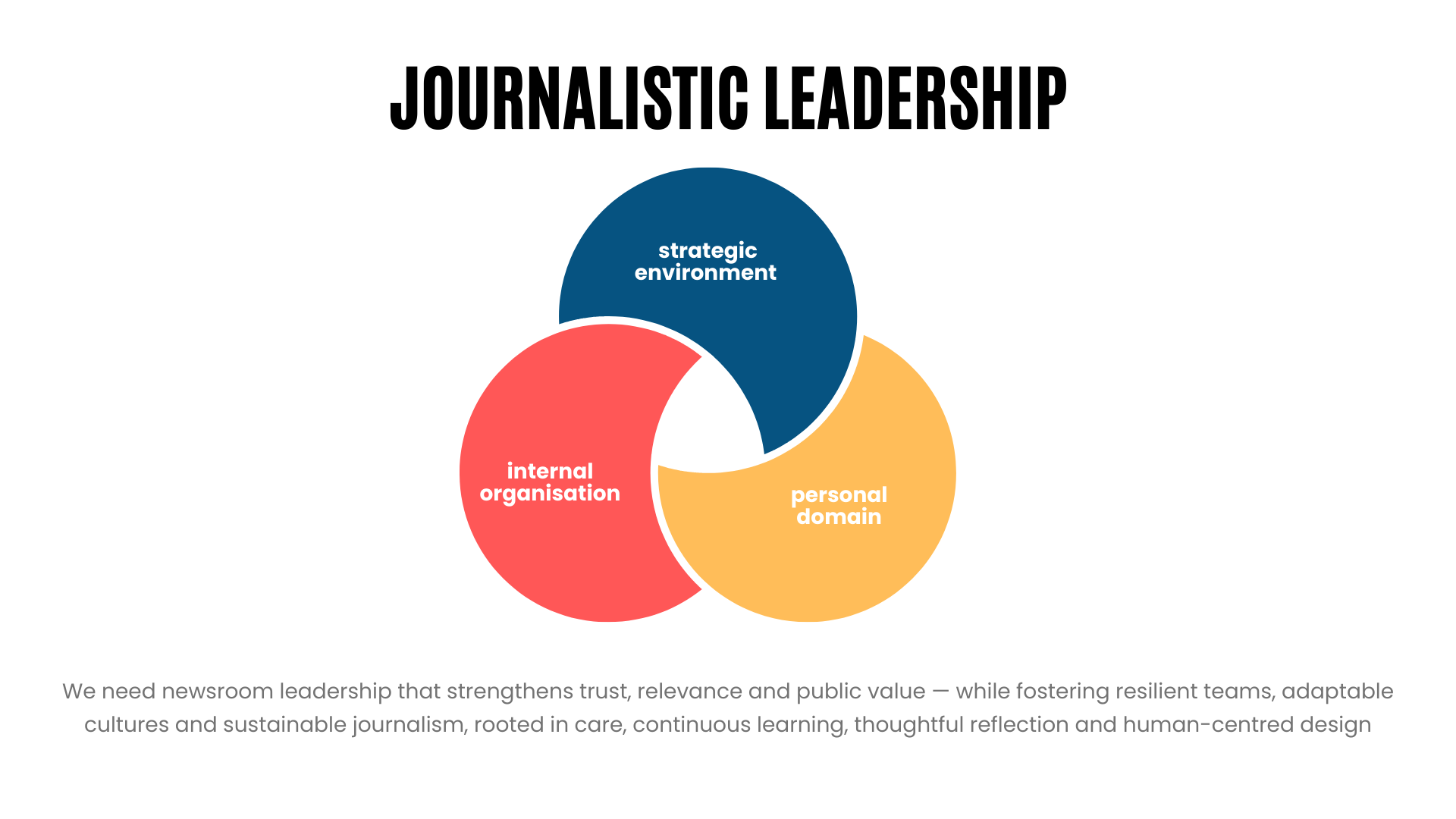
Drawing on research, practice, and the work of Lucy Kueng, Anita Zielina, François Nel (UCLan), Federica Cherubini and her colleagues at the Reuters Institute, as well as the leadership programmes developed at CUNY’s J+ initiative, among others, I see three domains where newsroom leadership takes shape.
Each domain calls for different skills, decisions and kinds of attention. Depending on your role – whether you’re a middle manager or an editor-in-chief, working in a traditional editorial position or in an audience, product or data role – the emphasis will vary. The way these domains interact also shifts. Yet together, they define the landscape in which leadership plays out.
Strong leaders move fluidly across these layers. They connect strategy with culture, and culture with personal resilience. Leadership is not a job title but a daily practice: holding course in uncertain times, creating a culture where people can thrive, and safeguarding your own energy and integrity.
These domains are not separate boxes to be ticked. They are in constant dialogue with each other. A strategic decision only takes root when it is lived out in the daily routines and culture of a newsroom. That culture, in turn, depends on the resilience and authenticity of the people leading it. And the way leaders manage themselves — their values, energy and presence — inevitably ripples out into team dynamics and the organisation’s ability to respond to its wider environment.
In other words: strategy without culture rarely sticks. Culture without resilient leaders risks becoming fragile. And personal leadership without strategic awareness can easily lose direction. The strength of newsroom leadership lies in navigating the interplay — shifting focus as contexts change, and ensuring that each layer reinforces the others rather than pulling against them.
The three domains, in practice:
- The strategic environment – finding direction in an unstable ecosystem
Example: An editor-in-chief decides to prioritise coverage of climate change, not just as a news beat but as a cross-cutting theme across formats and platforms.
Interplay: This only works if the newsroom culture allows for collaboration across desks, and if leaders at every level have the resilience to keep focus when daily pressures threaten to derail long-term priorities. - The internal organisation – from editorial routine to a learning newsroom
Example: A mid-level editor introduces short “learning slots” in weekly meetings where colleagues share insights from experiments with audience engagement.
Interplay: Such a practice strengthens culture, but it gains real momentum only when it aligns with the strategic priorities of the organisation and when leaders model openness to learning themselves. - The personal domain – leadership begins with yourself
Example: A section head realises they are drained by constant firefighting and begins blocking one hour a week for reflection and strategic thinking.
Interplay: This personal boundary-setting helps them make better long-term decisions, and it signals to the team that sustained energy and focus are valued — reinforcing both culture and strategy.
1. The strategic environment
Journalism today unfolds in a world that changes at breakneck speed – often described as VUCA: volatile, uncertain, complex and ambiguous. Leaders need to hold their course while technology, distribution, audience behaviour, competition and business models are all shifting at once. On top of that come unpredictable political developments, growing pressure on democratic values, and overlapping global crises that reinforce one another.
Generative AI is transforming how news is produced, distributed and consumed – while at the same time raising fresh demands for transparency and trust. Audience behaviour is shifting too: public trust in journalism is fragile, news avoidance is on the rise, and younger generations mainly encounter short, disconnected fragments on social media – creating what’s often called “context collapse”.
The competition for attention has never been fiercer. Creators and communities are building visible trust in full public view, while news organisations still do much of this work behind the scenes. And revenue models are in flux: traditional streams like ads and subscriptions are giving way to hybrid approaches – memberships, events, services and philanthropy – that depend heavily on brand trust and audience loyalty.
In this dynamic, leadership means making clear choices: what do we hold on to, what do we need to change, and how do we remain relevant and impactful for our audiences?
Key dynamics
- Technology – Generative AI is changing how journalism is made, distributed and consumed. It brings new opportunities for production and data analysis, but also questions of transparency, reliability and independence.
- Distribution – Audiences spend less time on owned channels and more on third-party platforms. The shift from linear to streaming, on-demand and social shows how dependent reach has become on external players. The so-called “traffic apocalypse” has made that vulnerability painfully clear.
- Audience – Trust is under pressure. News fatigue is rising, and more people are actively avoiding news. Younger audiences mostly see short fragments on social platforms, losing context and coherence. This demands fresh ways to rebuild relevance, closeness and engagement.
- Competition – Creators and communities reach millions directly, building trust by showing their expertise, being of service, and holding themselves accountable in public. Newsrooms often do this work out of sight – and could regain trust by making those processes more visible.
- Business models – Ads and subscriptions are giving way to hybrid forms: memberships, events, services, philanthropy. Their success relies on audience connection and brand trust.
Use cases
- Local community-building – A regional newsroom sees its Facebook reach halve in a year. Instead of chasing the algorithm, it sets up neighbourhood WhatsApp groups and a weekly community newsletter where residents contribute stories and ideas.
- Public interest start-up – A young, mission-driven investigative platform with member micro-donations produces high-quality journalism, but struggles with stable income and business know-how. By partnering with larger newsrooms and drawing on mentorship, the team builds expertise and networks.
Strategic questions
- What is our core mission – and is it still relevant to our audience?
- How would our content and distribution strategy look if reach and views were no longer the main KPIs?
- What role do trust and credibility play in our audience relationship – and how do we measure that?
- What can we learn from creators about community, authenticity and visible accountability?
- How do we harness AI and social media without compromising independence?
Development questions
- How do we make sure our story selection reflects audience needs, not just newsroom preferences?
- Which trends are we actively tracking – and which might we have dismissed too quickly as hype?
- How do we bring audiences into the process earlier, rather than only at publication?
- How do we explore new revenue models without diluting our mission?
2. The internal organisation
Inside newsrooms, the daily pressure of production increasingly clashes with the need to innovate and think long term. Tighter budgets and the introduction of AI are reshaping workflows, while agile methods and frameworks such as KPIs and OKRs are meant to drive efficiency – but in practice they can also put pressure on creativity and autonomy.
Multidisciplinary collaboration and human-centred, iterative design are still in their early stages in many places, and silos between editorial, tech, data and marketing often lead to misunderstandings and missed opportunities. At the same time, cultural expectations are shifting: younger colleagues want regular feedback, growth opportunities, and value diversity & inclusion. They also express their social engagement more openly, sometimes through employee activism.
Safeguarding sustainable careers – with attention to wellbeing, manageable workloads and financial security – has become a strategic priority. Audience interaction, meanwhile, is still not seen everywhere as a core task, even though it is crucial for relevance and trust.
All of this calls for leadership that can balance innovation with continuity, and build a working culture where collaboration, learning and care for people are at the centre.
Key dynamics
- Workflows – Routines and tight deadlines leave little space for reflection, experimentation and a culture of learning.
- Collaboration – Teams often bring together different disciplines, but don’t yet fully understand each other’s language or ways of working.
- Culture – Psychological safety, open feedback and respect for different working styles are not a given, yet they’re vital for renewal.
- Generations – Younger colleagues look for hybrid work and quick development; mid-career professionals seek balance and clarity; while senior staff value stability and craftsmanship. Leadership is about bridging these differences and making them strengths.
Use cases
- Cross-functional audience lab – Journalists, developers, marketers and data analysts work together on a single social issue, testing ideas directly with the public and evaluating what works.
- Generations on the newsroom floor – An editor-in-chief sets up intergenerational “work style sessions” to make expectations and preferences explicit, helping collaboration run more smoothly across age groups.
Strategic questions
- What does psychological safety look like in practice in our newsroom?
- Which silos hold us back – and how do we break through them?
- How can we make audience interaction a natural part of our work?
- Do we have structured time for reflection and feedback, or does it drown in daily production?
- How do we safeguard independence and rigour in data-driven working methods?
Development questions
- How well do colleagues understand and value the expertise of other disciplines in our organisation?
- When was the last time we evaluated our work with our audience?
- How do we ensure that different generations and working styles strengthen each other, rather than clash?
3. The personal domain
Leading in journalism today takes more than editorial direction. It’s relational and emotional work – at once being a compass, a coach, a buffer and an ambassador. The pressure of fast news cycles, shifting technologies and the high expectations of both audiences and team members demand strong self-awareness. Leaders need to be clear about their values and show them in daily decisions, even under pressure or when facing resistance.
Protecting your energy and setting boundaries is just as vital – it creates the headspace for strategic thinking, guiding your team, and making sound editorial choices. Mental resilience is increasingly important in a world full of uncertainty, setbacks and conflict. Younger colleagues expect regular feedback, development opportunities and attention to work–life balance, while diverse working styles within teams call for connecting, inclusive leadership. And to stay relevant, leaders must keep learning – both within and beyond their own organisation.
This domain is about using yourself consciously as an instrument: who you are, how you act, and how you stay connected to both the work and the people around you.
Key dynamics
- Self-knowledge and values – Knowing what you stand for and showing it in everyday actions. Making decisions that reflect your core values, even when that’s difficult.
- Energy and boundaries – Balancing strategic work, team support and editorial choices without burning out. That means setting limits and building in recovery.
- Mental resilience – Handling doubt, setbacks, pressure and conflict, and finding constructive ways through.
- Relational leadership – Building trust, having tough conversations, offering support and direction even in times of uncertainty.
- Continual learning – Staying curious, seeking feedback, learning from outside your own organisation, and adapting your approach as circumstances change.
Use cases
- Setting boundaries – A news editor realises she often provides solutions in meetings. She decides to start by asking two questions before offering advice, giving the team more ownership.
- Recovery moments – After an intense news period, a section head schedules a digital “reflection stop” with the team to discuss what went well, what could be improved, and how they’ll sustain themselves.
- Public learning – An editor-in-chief writes a blog not only about newsroom successes, but also about failed experiments and what they taught – signalling that mistakes and learning are part of the craft.
Strategic questions
- Which values guide my leadership – and do I live them every day?
- How do I guard my energy without making my team feel I’m unavailable?
- How do I deal with doubt and conflict without losing myself?
- How do I keep learning, even after years in a leadership role?
Development questions
- When was the last time I actively and genuinely asked my team for feedback?
- Which patterns or triggers do I recognise in myself under pressure?
- Which people or sources outside my organisation keep me sharp and inspired?
- What do I do consistently, beyond daily work, to strengthen my resilience?
The power lies in switching between domains
The three domains never stand alone:
- A new distribution strategy (environment) only works if there’s a culture open to experiment (organisation).
- A healthy culture (organisation) depends on reflective, resilient leaders (personal).
- Personal values (personal) lose strength if they don’t connect with external direction (environment).

Reflection exercise
- Draw three circles – one for each domain: strategic environment, internal organisation, personal leadership.
- Fill them in – note where you're currently spending most of your time ad energy. Be honest: what takes up your attention daily, weekly, or more structurally?
- Step back – look at the picture as a whole. Which circle dominates? Which one is left in the shadows, or only gets attention when there’s “time left over” Which one deserves more focus if you want to stay effective in the long run?
- Choose one small action – Pick a simple, realistic step you can take this month to bring things back into balance. For example 👇
- Stakeholder check-in – This month, reach out to one external partner, source or peer. Ask them directly: “What’s the key development or question in your world that our journalism should respond to?”
- Turn a trend into practice – Read one relevant report or trend piece (on audience behaviour, distribution or AI for example) and share a short 10-minute takeaway in your team meeting on how it might shape your work.
- Cross-silo experiment – Set up a small project where editorial, tech, data and/or marketing work together on one tangible (product) improvement – maybe a new format or way of engaging the audience.
- Shadow with a strategic lens – Spend an hour alongside someone in a different role (a data analyst, social editor, product owner). Capture at least one insight you can use straight away to better align editorial and product decisions.
- Strategic pause – Block one hour in your diary without email, phone or meetings. Use it to reflect on three questions: What’s most urgent now? Where can I make the biggest difference? What can I let go of?
- Leadership mirror – Invite one colleague or sparring partner to share a single observation about your leadership style that affects strategy or collaboration. Discuss how you might act on it.
💡 Tip: repeat this exercise every quarter. It helps you notice how your focus shifts – and ensures you’re not only caught in the daily rush, but also working on your role itself.

To conclude
With In the Lead, my intent is to create a space where we can examine, question and develop newsroom leadership together. A space where research and practice meet, and where examples from the field do more than inspire – they challenge us to think and act differently. Good leadership in journalism cannot be taken for granted; it is a structural condition for work that seeks to remain relevant, trustworthy and of public value.
I invite you to read, reflect and take part in this shared inquiry. Leadership in journalism is best understood not as an individual achievement but as a collective, situated practice – one that must be articulated, tested and developed together, and done openly, in full view.
💬 Got a case, insight or question to share? I’d love to hear from you.
📩 Want the next edition delivered automatically? Subscribe here.
🔁 Think a colleague would find this useful? Feel free to pass it on.
Until next time,
Karlijn
In the Lead: Navigating Newsroom Leadership is the English edition of my monthly newsletter. The Dutch version – In de Lead: Bouwstenen voor Journalistiek Leiderschap – is available on LinkedIn.
As any Dutch person will tell you, speaking multiple languages is second nature. Publishing in both English and Dutch allows me to contribute to the international discourse on newsroom leadership and journalistic culture, while also supporting the Dutch sector – where, until recently, there was no structured approach to leadership development in journalism. The Dutch edition marks the first step in building such a framework, and a movement is slowly beginning to emerge.
I am deeply committed to this work, and equally eager to learn from international colleagues. If you have reflections, questions or ideas to share, I warmly invite you to get in touch.