Young people are not switching off from news. They are organising their relationship with it differently.

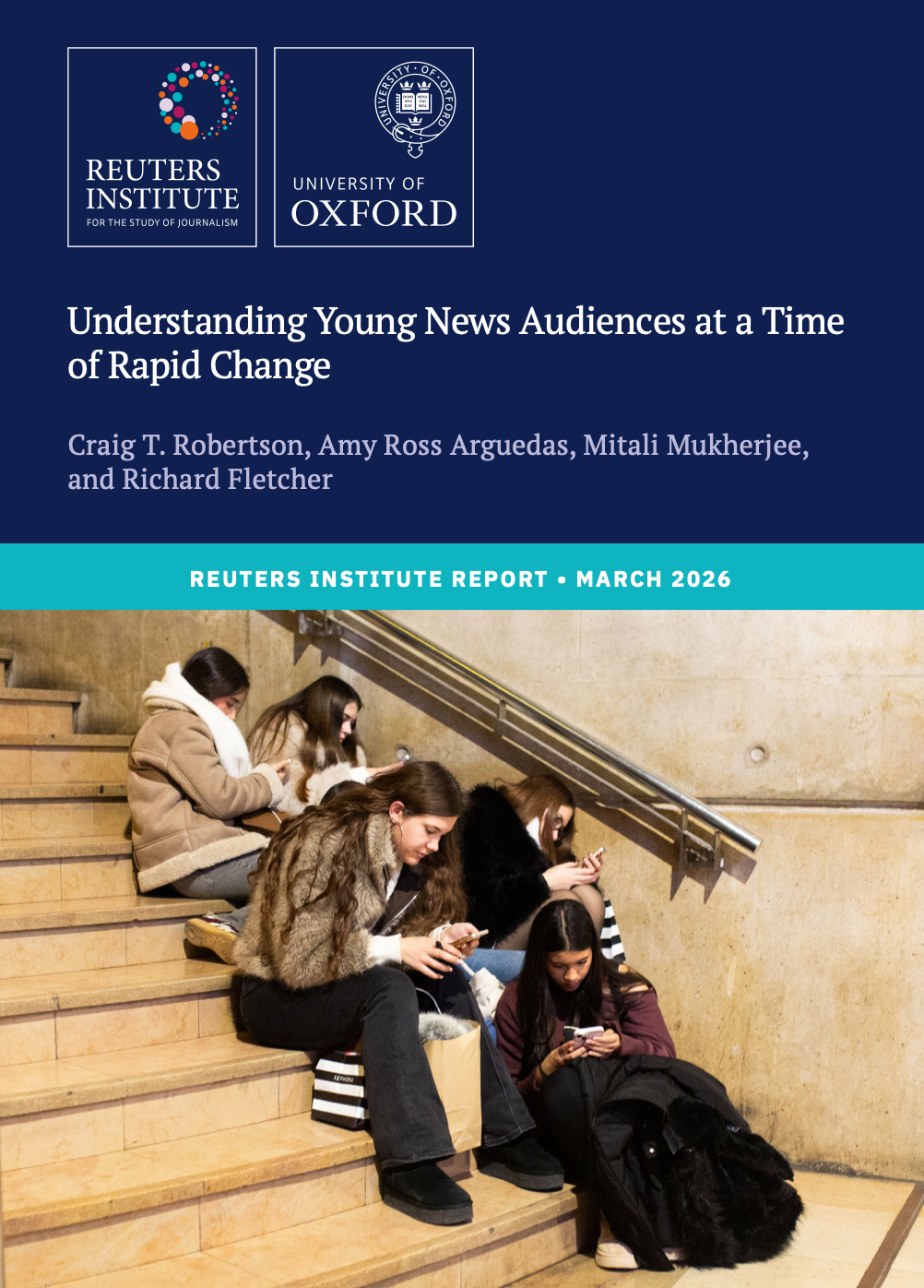
Recently, I read two studies side by side that complement each other strikingly well. The first is the new Reuters Institute report, Understanding Young News Audiences at a Time of Rapid Change. The second is the recent article Managing media use: How young adults deal with information abundance by Tim Groot Kormelink, Mirte Braan and David van de Kar, on how young adults manage their media use in a time of information overload.
What struck me is not that these studies reveal something entirely unexpected. Much of it will already feel familiar to anyone working in newsrooms: in audience data, reach figures, editorial conversations, and in what younger colleagues and users tell us. But that is precisely why these studies matter. They force us to stop treating these signals as isolated observations and start recognising them as part of a structural shift — one that journalism, and journalism leadership, needs to respond to far more quickly.

From online-first to social-first: the bigger picture
The Reuters Institute sets out that bigger picture clearly. Over the past decade, young people have moved from being online-first to distinctly social-first in their news habits. In 2015, 18–24-year-olds still tended to access news primarily via publisher websites and apps. Today, social media is their main gateway to news.
They also move far more naturally through an audiovisual environment. TikTok, Instagram and YouTube have become much more central to news consumption than Facebook. On social platforms and video-based services, they are more likely to pay attention to individual creators or personalities than to traditional news brands. And compared with older audiences, they are more inclined to watch or listen to news rather than read it. At the same time, they consume news less frequently than older groups: 64% say they access news daily, compared with 87% of over-55s. Only 35% describe themselves as very or extremely interested in news, compared with 52% of older adults.
These are significant figures. But what the Reuters Institute does well is warn us against drawing the wrong conclusion. The story is not simply that young people are turning away from news. The story is that they are consuming it differently: less intentionally, more incidentally, and more deeply embedded in broader streams of media, entertainment, social interaction and everyday routines.
The report also shows that younger users are more likely to see traditional news as irrelevant to their lives, harder to understand, or insufficiently representative of their generation. Around a third of 18–24-year-olds say people their age are not represented enough in the news, and 35% feel that coverage of their generation is unfair. When it comes to news avoidance — an area that Kiki de Bruin’s recent and insightful doctoral research also helps illuminate — younger people are more likely to say that news does not feel relevant to their lives or is simply too difficult to follow.
What they are doing instead: media use as a daily strategy
This is exactly where the research by Tim Groot Kormelink and colleagues becomes so valuable. While the Reuters Institute shows us what is changing at scale, this study helps us understand, from the inside, how young adults are trying to live with information abundance.
Their starting point is not platform, device or genre, but function. Young adults, they argue, do not primarily organise their media use by channel, but by what media do for them in daily life. Those functions are: being in the loop, maintaining connection, and zoning out. Across five domains — information, emotion, attention, social relationships and self-presentation — they try to plan, organise, motivate and correct their media use.
That is a much richer and more human perspective than the lazy cliché of “young people glued to their phones”.

For journalism, the most relevant of these functions is being in the loop. Groot Kormelink, Braan and Van de Kar show that young adults organise their information environment in ways that allow news to reach them without dominating their lives. They do want to know what is going on, but not in a way that constantly demands attention, energy or emotional space.
So news does not always need to be actively sought out. It needs to be able to flow past them — through social feeds, push notifications and the people around them. That flow requires some initial set-up: turning on notifications, following news brands, adjusting feeds. But once that infrastructure is in place, effortlessness becomes crucial.
One participant in the study puts it neatly: “I think [news] comes to me, yeah I’m on Insta much more than on those news apps, so I think I get most news information from there, and [push] notifications from [major Dutch news media], and actually based on that I only read more if I want the information elaborated.”
This kind of ambient awareness helps young people feel they are not missing anything essential, while also protecting them from the emotional impact of too much negative or overwhelming news. News remains within reach — but usually at a safe distance.
Not disengagement, but a form of coping
That, to me, is perhaps the most important connection between the two studies. The Reuters Institute shows that young people encounter news more often than they actively seek it out, and that their use is therefore more social, more fleeting and less directly tied to news brands. Groot Kormelink and colleagues show that this is not only a difference in distribution. It is also a coping strategy in a time of information overload.

Being in the loop is not a watered-down form of civic engagement. It is a workable form of public orientation: taking in enough to know what matters, without constantly exposing yourself to cognitive and emotional overload.
What Reuters identifies at a macro level as declining frequency and growing incidental exposure becomes, in the second study, visible as a daily practice of information management.
From reach to relevance: what this asks of journalism
This also changes how we should think about journalistic relevance.
In many newsrooms, the dominant reflex is still one of reach: how do we get young audiences back to our homepage, our app, our brand? But read together, these two studies suggest a different question: how do we make journalism work within the ways young people already organise their daily lives?
That requires more than distributing journalism in different places. It requires new forms of usefulness.
An explainer video, a strong Q&A, a push notification that already tells part of the story rather than simply trying to lure someone into clicking, a visual timeline, a headline that immediately signals relevance — these are not concessions to superficiality. They are forms of journalistic craft better suited to today’s information practices.
The Reuters Institute is unusually concrete on this point. Notifications can work as small micro-stories. Audio and video are no longer secondary formats. News must not only be discoverable; it must also prove worthy of attention.
News competes not only with information, but with life
Another important strength of the paper by Groot Kormelink, Braan and Van de Kar is that it shows not all media land in young people’s lives in the same way.
Maintaining connection and zoning out are experienced very differently. Contact media — especially WhatsApp, email and sometimes Snapchat — demand constant attention, but are not usually experienced as intrusive. They are so deeply woven into social relationships that their constant presence feels almost natural.
Media used for relaxation, by contrast — such as Instagram, TikTok or YouTube — are much more heavily moralised. Young people often try to limit them actively: with timers, folders, browser versions or by deleting apps altogether. These media are enjoyable, but they also generate guilt, frustration and a sense of diminished self-control.
The study describes this very sharply as a paradox of attention: media for connection are not experienced as disruptive, while leisure media are often seen as interfering and morally suspect.

This, too, helps us read the Reuters findings more carefully. When young people say news feels irrelevant, difficult to follow, or damaging to their mood, this is not only about content preferences. It is also about the place of news within a media environment that is already crowded, socially loaded and emotionally demanding.
News does not only compete with other information. It competes with the need for connection, rest, escapism and self-preservation.
That younger audiences turn more often to audiovisual formats, pay more attention to creators, or use AI to make complex stories easier to understand can then be read as a search for manageability, proximity and translation. The Reuters report notes that 15% of 18–24-year-olds use AI for news on a weekly basis, compared with 3% of over-55s, and that younger people are more likely to use AI to simplify complex news stories. That is not a minor detail. It suggests that, for part of the audience, journalism is no longer consumed only as a finished product, but also as something that needs to be filtered, summarised and translated along the way.
Young people have not abandoned journalistic values
There is a third layer in the Reuters report that matters just as much for our profession. Young people are often assumed to be fundamentally different from older audiences in how they think about journalism. But the report suggests otherwise.
Differences in trust, fairness and impartiality are mostly differences of degree, not of kind. Young people trust news somewhat less — 37% versus 46% among over-55s — but the gap is smaller than public debate often suggests. Most still want facts and fairness.
What is different is how those values need to be expressed. Younger users are more likely than older ones to say that neutrality does not make sense on some issues: 32% compared with 19% among over-55s. They are also more likely to feel that their generation is underrepresented or unfairly portrayed.
These are not signs that professional values no longer matter to them. They are signs that those values need to land differently: less as an institutional claim, more as a transparent, explainable and verifiable practice.

What this means for journalism leadership
Taken together, both studies speak directly to newsroom leadership.
Because ultimately this is not only about “reaching young people”. It is about the professional frame we ourselves are using. Do we still see journalism mainly as the production of reliable content? Or also as helping people organise public orientation in a fragmented, platform-driven and emotionally overloaded environment? Do we treat formats as packaging, or as a meaningful part of public value? Do we still think primarily in terms of loyalty to brand and homepage, or also in terms of how journalism fits into people’s daily lives?
To me, that is the real value of reading these two studies together. The Reuters Institute gives us scale, direction and urgency. Groot Kormelink and colleagues provide the everyday logic, nuance and meaning. One shows that young people are clearly social-first, more audiovisual and less directly brand-led in their news use. The other shows that this is not a passing lifestyle phenomenon, but deeply connected to how young adults manage information, emotion, attention and social relations in daily life.
Together, the studies do more than show that young people use news differently. They show that journalism needs to adapt its professional story more quickly to the reality in which young people live.

The real challenge
Perhaps that is why I find these studies so illuminating. They do not tell us that young people have become indifferent. They tell us that the conditions under which news can feel relevant have changed.
And that means the challenge for newsrooms goes well beyond distribution. It touches products, workflows, storytelling forms, editorial standards, organisational culture and the assumptions that sit beneath them. It asks whether we are organising journalism in ways that do not just reach people, but help them stay in the loop without becoming overwhelmed. It asks whether we define relevance not only through our own editorial idea of what counts as news, but also through the ways people actually live with media.
For my own work on journalism leadership, that is the heart of the matter. How do you translate strategic shifts in the outside world into what is needed inside the organisation — in routines, formats, audience work and talent development? And perhaps even more fundamentally: which assumptions about audiences, news use and journalistic authority do we need to revisit?
For example:
- that audiences are loyal to brands rather than to context and moment
- that relevance comes from reach rather than usefulness
- that more information automatically produces better-informed citizens
- that attention is endlessly available
- that journalistic value lies mainly in what we produce, rather than in what journalism does in people’s lives
And if those assumptions are changing, what does that mean in practice?
How do you create room in a newsroom to work from the principle of being in the loop, rather than only from the principle of full coverage? How do you make time and legitimacy for formats that help people understand, summarise and navigate — not only for speed and exclusives? Which behaviours do you reward: maximum output, or demonstrable meaning for audiences? When is something “good enough” to publish — and when does it only become valuable if it genuinely lands? And how much room do teams have to experiment with forms that may deliver less reach, but more relevance or impact?
I would be very interested to hear how others see this.
What do you already recognise in your own practice? Where do you see these shifts showing up in products, editorial culture or audience strategy? Where does it still rub — editorially, practically or culturally? And just as importantly: where do you already see examples, in your own newsroom or elsewhere, of journalism that responds well to this reality? What choices — in form, tone, workflow or leadership — are making the difference there? And what does that ask of us as leaders: in what we prioritise, what we measure, and what we are willing to let go of?
And for colleagues who want to keep thinking about this: please do feel free to get in touch beyond this newsletter as well. I would be glad to talk — especially about the practical and often messy questions underneath these insights, and what they ask of editorial choices, organisation and leadership. A coffee is easily arranged.